“The heartfelt themes of this incarnation, directed by Thomas Caruso and Matthew Warchus, who directed in 2019, are sharing and community. The result feels more like an uplifting ensemble drama.”

‘A Christmas Carol’ Review: A Gentle Interpretation of a Classic 🔗
Tim TeemanNY Times

This production, which retains many of the charms of its 2019 Broadway staging, has lost some of its necessary darkness.

In some ways, Jack Thorne’s version of “A Christmas Carol” feels like its own Ghost of Christmas Past. It first played in New York on Broadway — having premiered at London’s Old Vic Theater — in late 2019, just before Covid led to an 18-month shutdown of Broadway. That production was praised for restoring the story’s social conscience and including charming bits of audience interaction; it won five Tony Awards, including for best original score.

So now, as before, upon entering the theater, this time the Perelman Performing Arts Center, audience members are offered tangerines and ginger cookies, from company members proffering baskets, or gently lobbed from the stage to outstretched hands in the audience.

The heartfelt themes of this incarnation, directed by Thomas Caruso and Matthew Warchus, who directed in 2019, are sharing and community. Gone from this tale of Scrooge’s journey to joy is a full account of his life’s prior darkness. The result feels more like an uplifting ensemble drama.

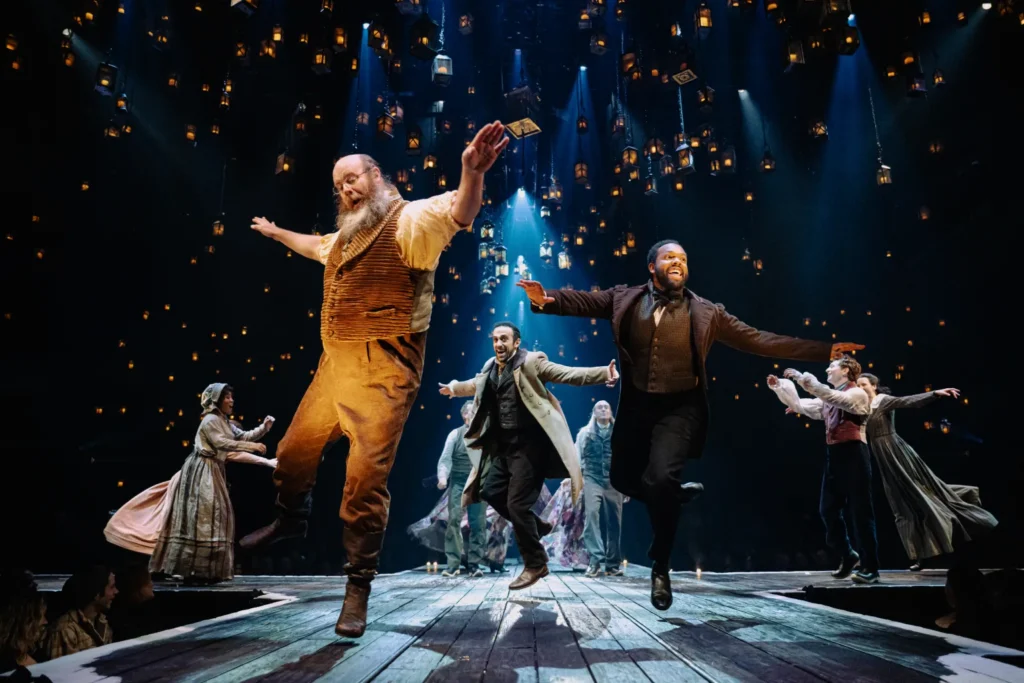
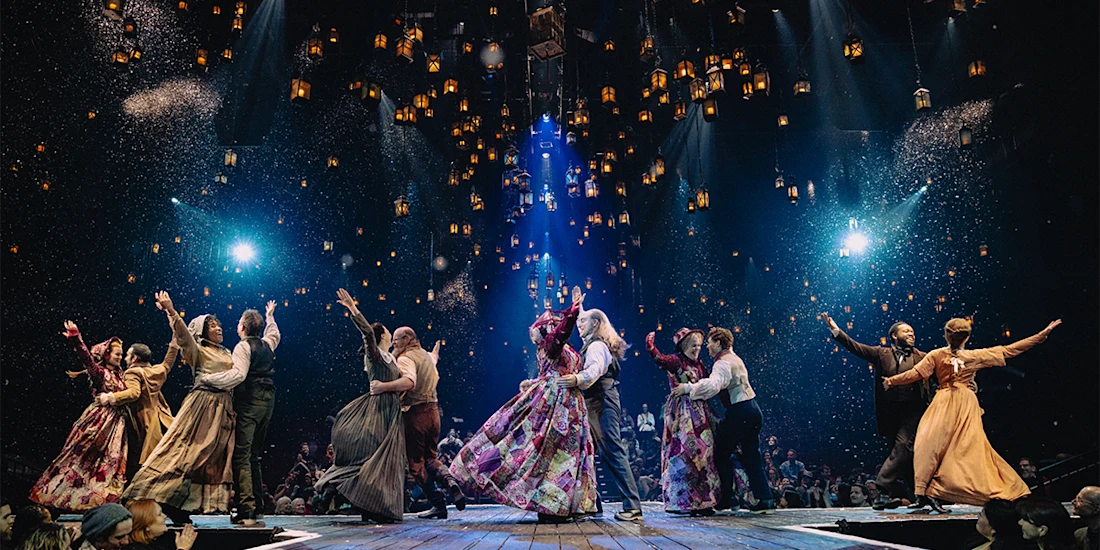
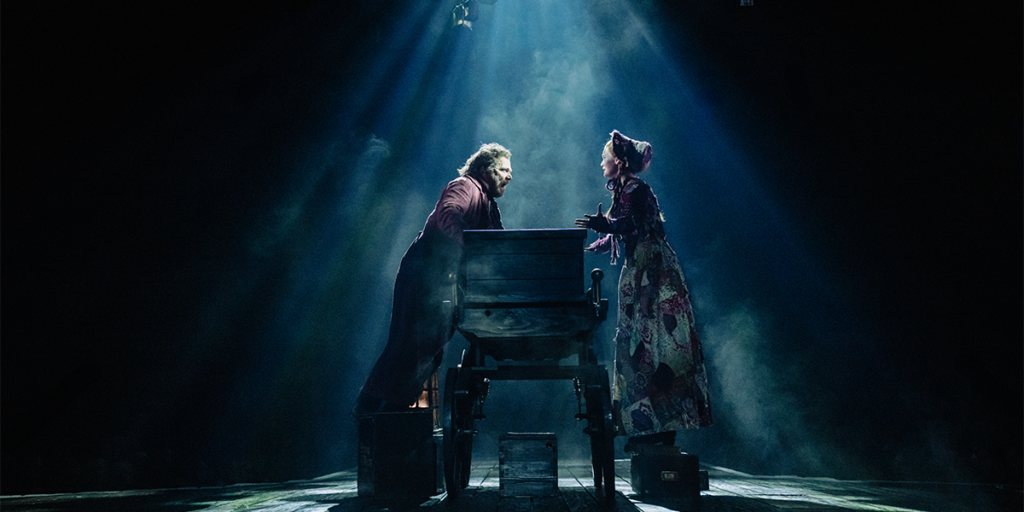
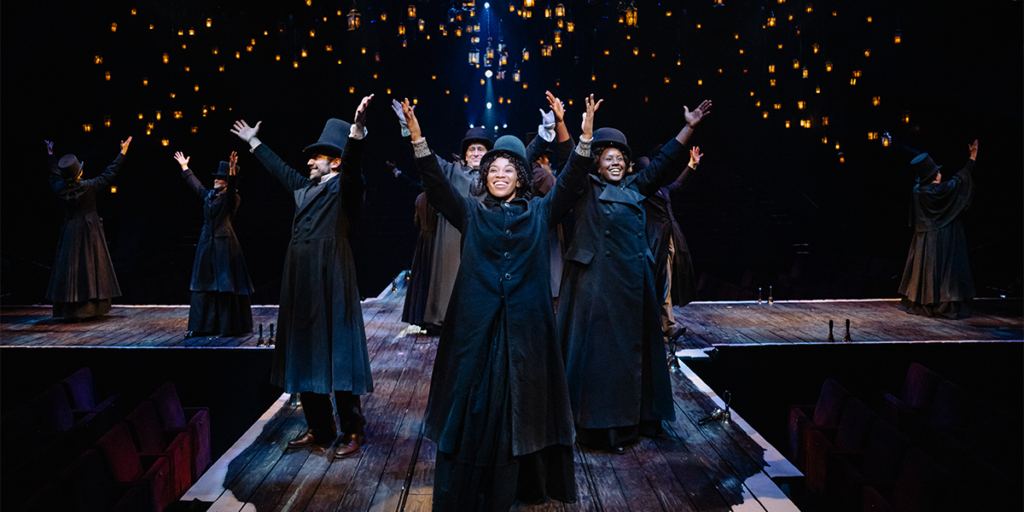
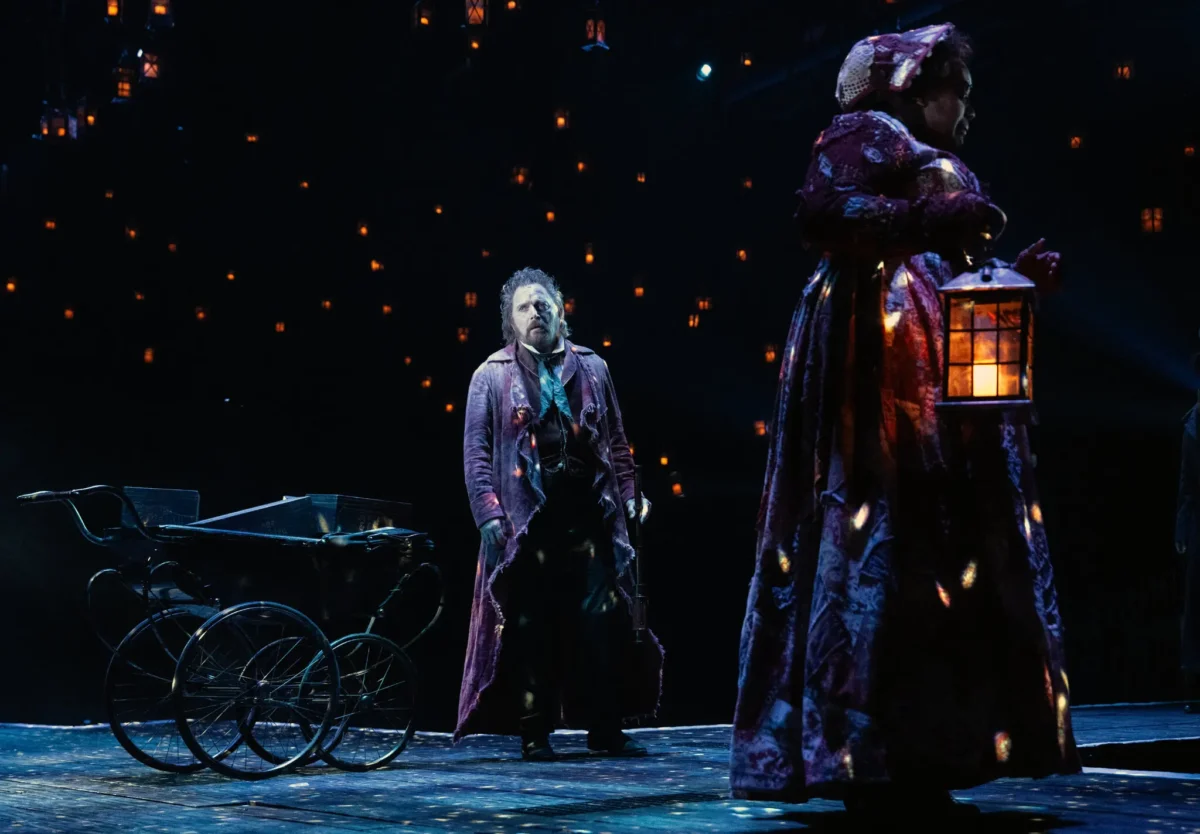
The true star is Hugh Vanstone’s lighting: A ceiling dotted by bobbing mini-lanterns (and one that is forbiddingly large, and swings), and flashes of darkness to aid the jump-scares of Scrooge’s transformative night. Rob Howell’s costumes are Dickens-era austere, and his stark, effective set centers on four paths intersecting at a cross. There, four metal frames rise from the floor and descend to signify both physical doors and the psychological barriers imprisoning Scrooge (Michael Cerveris) in his past regrets and present-day miserliness.

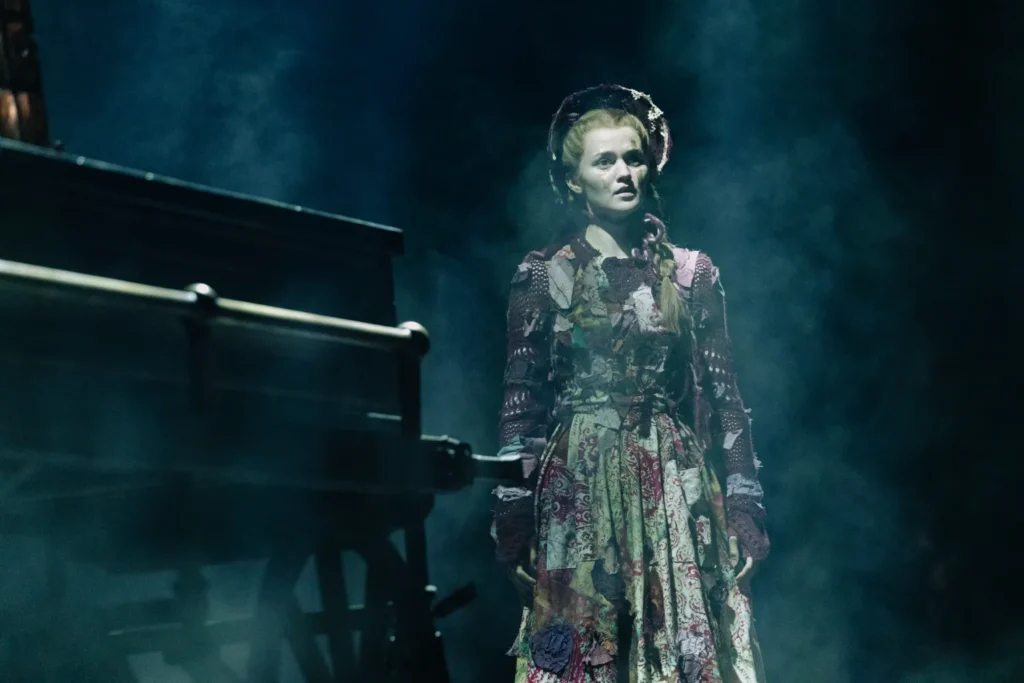
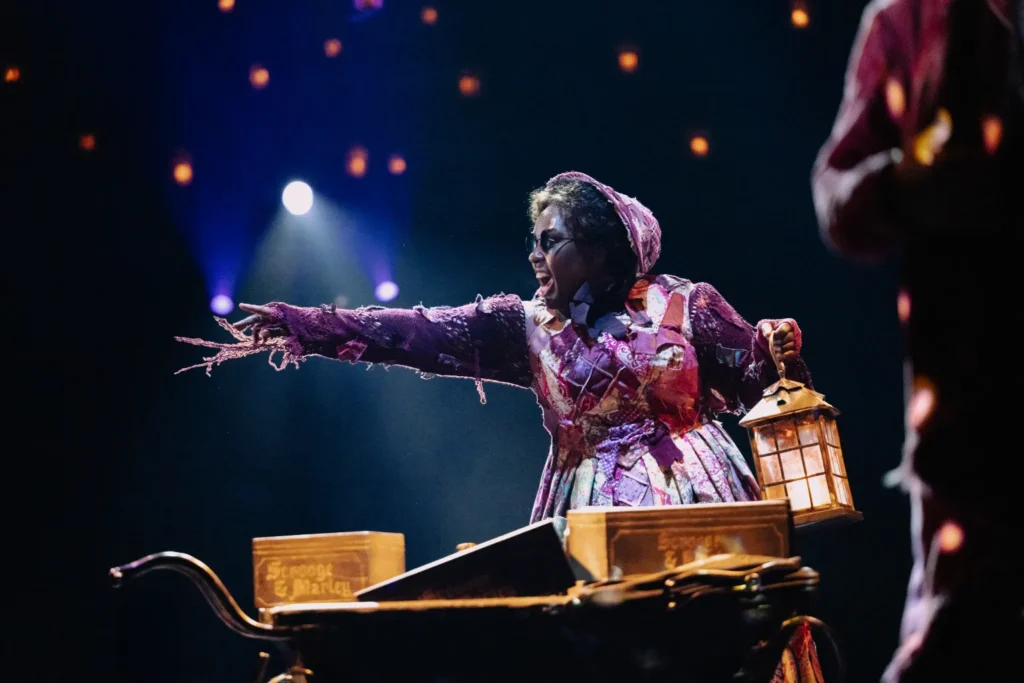
Scrooge is assailed from all directions by the Ghosts of Christmas Past (Nancy Opel), Present (Crystal Lucas-Perry), and Future (Ashlyn Maddox). The spirits, in colorful dress, are more imperiously commanding than terrifying, as they try to show Scrooge the errors of his ways.

The Ghost of Christmas Present is Mrs. Fezziwig, wife of Scrooge’s former employer, while Future is Little Fan, Scrooge’s dead sister and mother of his ebullient nephew Fred (George Abud). Warchus and Lizzi Gee (credited for movement) ensure that the intersecting paths swirl with action and gorgeous carol singing as Scrooge is taken on his supernatural journey.

The challenge for any “Christmas Carol” is to reimagine its protagonist’s state of mind and his route to change. A typically excellent Cerveris plays Scrooge first as cantankerous, but also funny (you understand why he’s annoyed by the carolers at his door). He looks battered, weatherworn and exhausted within his own shell of meanness, with a ratty mane befitting an aging metal head. And yet, a little to its detriment, this is not simply Scrooge’s show; the other characters — particularly the ghosts — feel just as prominent. But giving us more Scrooge would deepen the impact of his awakening on Christmas morning, full of a determination to change.

Of the other actors, Julia Knitel gives a nuanced edge to Belle, Scrooge’s love when he was a cheerful young man. One of the show’s best scenes sees Scrooge approach an older Belle in the present when, transformed, he wonders if they might have a future together.

The Cratchits’ Tiny Tim (Micah Fay Lupin and Izzy Elena Rita share the role; an excellent Rita the night I saw it) is far from a physically vulnerable child to feel sorry for, but a key player who, in a touching scene with Cerveris, teaches Scrooge a climactic, quiet lesson in generosity that is more profound than anything gleaned from the ghosts.

Such moments of stillness are welcome, considering the hasty gallop at which the show approaches the rest of Scrooge’s story. Perhaps the production assumes an audience’s universal familiarity, perhaps it’s mindful of a two-hour run time, but Cerveris is given more story points to hit than psychological depths to plumb.

However, darkness is not what this “Christmas Carol” is about, or where it wishes to dwell. This version relishes simpler things, such as its centerpiece sequence of a newly transformed Scrooge giddily greeting and shaking hands with the audience and overseeing a cavalcade of potatoes, sprouts, apples, oranges and a ginormous bronzed turkey, all transported to the stage via fabric chutes and rope. Amid this bounty, the audience is encouraged to donate to River Fund, a provider of emergency food in New York City.

Toward the end, the ghosts wonder if Scrooge might soon forget what he has learned. But the choice and responsibility to change — and our own, the play underlines — is down to him, down to us. This haunting-as-therapy complete, and with a “Silent Night” orchestrated by the ringing of hand bells and accompanied by falling snow, the audience undertakes a final exercise in collective action: navigating the Perelman’s endless maze of stairs and corridors to the exit.

A Christmas Carol
Through Jan. 4 at the Perelman Performing Arts Center, Manhattan; pacnyc.org. Running time: 2 hours 15 minutes.
“A Christmas Carol, starring Michael Cerveris, is tight as a drum and pretty as a picture.”

A Christmas Carol, Starring Michael Cerveris, Is Tight as a Drum and Pretty as a Picture 🔗
Hayley LevittTheatermania

The Tony-winning Old Vic production returns to New York at the Perelman Performing Arts Center.

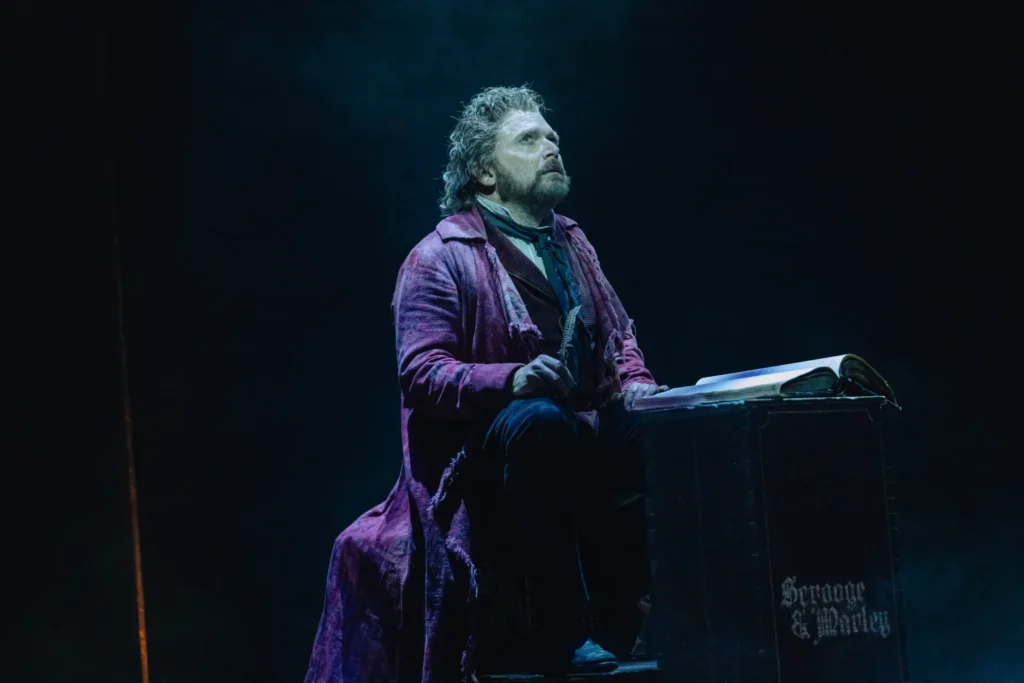
Michael Cerveris as Ebenezer Scrooge in A Christmas Carol at the Perelman Performing Arts Center
(© Andy Henderson)

Festive fiddling. Tight-harmony wassailing. Tony-nominated actors lobbing gingerbread cookies and clementines at you.

The charm of playwright Jack Thorne and director Matthew Warchus’s analog and ultra-theatrical adaptation of A Christmas Carol knows no bounds, and that’s exactly how it’s become the wheat winnowed from the holiday chaff. It’s a staple of London’s winter season, now back at the Old Vic for its ninth year. Simultaneously, it’s making a welcome return to New York (co-directed by Thomas Caruso) for the first time, but likely not the last, since the 2019 Broadway premiere that earned five Tony Awards. (It was the truncated year of the Covid shutdown, but still, that much hardware is rare for a seasonal show.)

To see Scrooge and all his Dickensian specters this time, you’ll have to navigate the Perelman Performing Arts Center’s sterile maze of modern architecture. But your escape from the labyrinthine hallways will be rewarded with a view of set designer Rob Howell’s constellation of floating lanterns—a sight that cures hypertension and dispels all thoughts of commercial real estate.

Ashlyn Maddox as the Ghost of Christmas Yet to Come in A Christmas Carol
(© Andy Henderson)

For a ghost story about the perils of greed, that’s not a bad place to start (both Howell and lighting designer Hugh Vanstone earned Tonys). Paired with Howell’s intricate Victorian costumes and composer Christopher Nightingale’s shimmering underscoring (another Tony-winning commodity performed by wonderful musicians), the whole experience feels like breathing in a fragrant library book next to a cozy fireplace.

Top-tier performers are the ones who read to us, the X-shaped stage their hearth. We are sealed in Thorne and Wharcus’s Victorian fantasy world. But not the one where miserly moneylender Ebenezer Scrooge has his crisis of conscience; the one where the actors, using their real names, shuffle through the aisles doling out their festive pre-show snacks. It’s a subtle but effective remove that allows for broader performances and a breezy pace.

Crystal Lucas Perry as the Ghost of Christmas Present in A Christmas Carol
(© Andy Henderson)

Michael Cerveris plays a classically gruff Scrooge who melts into a warm sincerity by the end of his haunted Christmas Eve. Playing the three ghosts who inspire his change of heart are Nancy Opel, a frank Ghost of Christmas Past; Crystal Lucas-Perry, a bulldozing, Caribbean Ghost of Christmas Present; and Ashlyn Maddox, our sweet Ghost of Christmas Yet to Come who appears in the form of Scrooge’s beloved sister Fan.

Maxim Chlumecky shares the stage with Maddox as a fresh-faced Young Ebenezer, but Cerveris performs most of Scrooge’s memories himself. Most affecting are the ones with his lost love, Belle, played with equal parts muscularity and softness by Julia Knitel. The device gets even richer when Scrooge, reborn, pays a visit to Belle on Christmas Day. She remains the young Belle of his memory, and it’s beautiful.

The company of A Christmas Carol at the Perelman Performing Arts Center
(© Andy Henderson)

The cast of riches continues with George Abud as Scrooge’s jolly nephew Fred, Chris Hoch (a veteran of the Broadway production) doubling as Marley and Scrooge’s cruel father, Paul Whitty as the pure-hearted Fezziwig, and Rashidra Scott as a Mrs. Cratchitt who gets to show off her stunning voice thanks to this production’s musical throughline.

But of course, it’s not A Christmas Carol without that tear-jerking pair, Bob Cratchit (Dashiell Eaves, also reprising his Broadway role) and Tiny Tim (played at my performance by Micah Fay Lupin). Their parts are small, but their pathos is working overtime as the face of Dickens’s surreptitious protest of child labor conditions (in that spirit, this production is partnering with the poverty-fighting nonprofit organization River Fund). Sure, a logically argued polemic is fine. But have you ever tried gently falling fake snow and an adorable child with a handbell? Your heartstrings, and your purse strings, won’t stand a chance.

“A festive feast for the soul. It’s Christmastime in the city, and you can hear the silver bells ring off Broadway in A Christmas Carol – quite literally. Of the many traditional carols performed in this production, those performed with a full bell choir stunned my audience into awed silence. And shock and awe are just the beginning of the emotions this evocative production hopes to stir up.”

‘A Christmas Carol’ Off-Broadway review — a festive feast for the soul 🔗
Austin FimmanoNY Theatre Guide

It’s Christmastime in the city, and you can hear the silver bells ring off Broadway in A Christmas Carol — quite literally. Of the many traditional carols performed in this production, those performed with a full bell choir stunned my audience into awed silence. And shock and awe are just the beginning of the emotions this evocative production hopes to stir up.

The first, most gorgeous sight when you enter the spacious theatre are the hundreds of lanterns hanging from the ceiling, the sheer scale of them enough to dazzle. They instantly conjure a night sky, but they also hearken back to a nostalgic, Victorian vision of Christmas like the one the story is set in. The lanterns aren’t just for show, either. Hugh Vanstone’s lighting design heightens the drama — and, where necessary, the spookiness — of Ebenezer Scrooge’s story.

Two-time Tony Award winner Michael Cerveris (Fun Home on Broadway, The Gilded Age on HBO) stars as the miser. He performs Scrooge’s cold-hearted tirades and blustery “bah, humbugs” with just the right amount of snarl, raging against meek but kind Bob Cratchit (Dashiell Eaves) and jolly nephew Fred (George Abud). But as Scrooge’s heart is forced to crack open, Cerveris really shines. His performance is so heartfelt and endearing that when Scrooge finally cries out “Merry Christmas!”, my entire audience gave him a rousing round of applause.

A Christmas Carol, adapted by Harry Potter and the Cursed Child playwright Jack Thorne and directed by Matthew Warchus (co-directed for PAC NYC by Thomas Caruso), is fittingly tweaked for the modern audience. The original 1843 story has aged remarkably well into 2025, but additions like Scrooge’s sister Fan (Ashlyn Maddox) as the Ghost of Christmas Yet to Come and a heartfelt scene of closure with Scrooge’s one-time fiancée Belle (Julia Knitel) flesh out the story in a cathartic way.

There’s a reason we keep telling the story of A Christmas Carol nearly 200 years after it was first published. This production, with its perfect balance of spooky and saccharine, sums it up. It reminds us of the eternal message of cherishing people over money, not just at Christmas, but in life.

A Christmas Carol summary

Based on the 1843 novella by Charles Dickens, A Christmas Carol follows miserly old debt collector Ebenezer Scrooge in Victorian England. Though he is surrounded by loving people, like his mistreated employee Bob Cratchit and his persistent nephew Fred, he spurns human connection.

In the early morning hours of Christmas Day, he is visited by the Ghosts of Christmas Past, Christmas Present, and Christmas Yet to Come. Each ghost tries to show Scrooge the error of his ways by forcing him to reexamine his own life and embrace the spirit of Christmas.

What to expect at A Christmas Carol

As audiences take their seats, the performers — all in their dark-colored Victorian caroler costumes — hand out gingerbread cookies and clementines to anyone who wants them. At my performance, a cast member even tossed clementines from the stage into the eager hands of audience members.

Jack Thorne’s adaptation of A Christmas Carol has been an annual staple at the Old Vic in London since it premiered in 2017, and this production marks its return to NYC after a seasonal run on Broadway in 2019. Unlike on Broadway, PAC NYC’s nontraditional staging allows audiences to experience the play in a semi-immersive setting. The effect is really felt at the climax, when an entire Christmas feast flies over the audience and onto the stage.

What audiences are saying about A Christmas Carol

With 20 reviews posted at the time of publication, A Christmas Carol has a 93% audience approval rating on the review aggregator Show-Score. Viewers raved about the inventive staging and the feel-good Christmas spirit of the show.

  • “Uplifting and enlightening. The performers were bang on and absolutely perfect. Loved the bells.” – Show-Score user Michael M
  • “Extremely creative and engaging staging of this classic story.” – Show-Score user Ashley G
  • “Not only did they make this show immersive, but they truly knew how to touch everyone’s heart strings.” – Show-Score user Brooklyn H

Read more audience reviews of A Christmas Carol on Show-Score.

Who should see A Christmas Carol

  • A Christmas Carol is a perfect show for families, especially families with children, to go to and celebrate the holidays together.
  • Theatregoers who love lightly immersive theatre will be entertained by the way this production constantly spills off the stage.
  • Anyone looking to get in the holiday spirit will find all the trappings of a nostalgic Christmas here: Victorian carolers, classic Christmas music, and the happy ending of this most classic Christmas story.

Learn more about A Christmas Carol off Broadway

With its stunning blend of heartfelt storytelling, traditional carols, and an immersive Christmas feast, A Christmas Carol is sure to spread holiday spirit to all who see it.

Learn more and get A Christmas Carol tickets on New York Theatre Guide. A Christmas Carol is at the Perelman Performing Arts Center (PAC NYC) through January 4.

Photo credit: A Christmas Carol off Broadway. (Photos by Andy Henderson)

“Directed with no-holds-barred fervor and laughs by Thomas Caruso, the meta-theatrical femalecentric comedy stars the blockbuster cast of stage and screen favorites Caroline Aaron, Brooke Adams, Marilu Henner, and Melanie Mayron as the Baby-Boomer buddies since college some 40 years ago, who offer their insights into aging, men, the next generation, life, each other, and the never-ending challenges of being a woman…Highly entertaining, funny,
and relevant.”

Old friends battle and bond over birthday brunch in ‘Madwomen of the West’ at Off-Broadway’s Actors Temple Theatre 🔗
Deb MillerDC Theater Arts

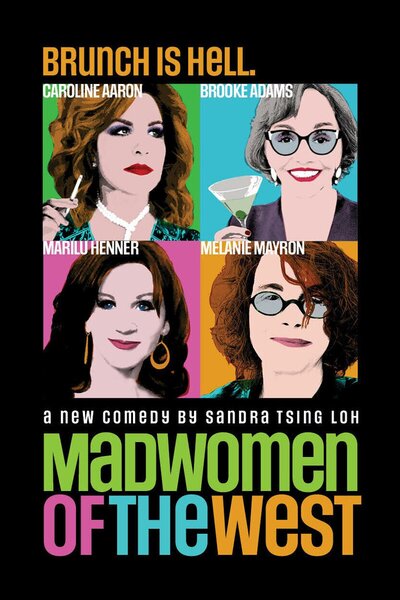
When Marilyn decides to throw a surprise birthday brunch for Claudia at Jules’ sleekly furnished $10 million Brentwood home, Zoey, a successful actress-turned-Yoga-advocate who’s been living in London, shows up unexpectedly, drinks flow and personalities clash, as the four long-time friends of a certain age share their opinions, open up about their personal problems (Marilyn’s is a doozy), battle and bond, in the Off-Broadway premiere of Sandra Tsing Loh’s Madwomen of the West, playing a limited engagement at Actors Temple Theatre. Directed with no-holds-barred fervor and laughs by Tom Caruso, the meta-theatrical femalecentric comedy stars the blockbuster cast of stage and screen favorites Caroline Aaron, Brooke Adams, Marilu Henner, and Melanie Mayron as the Baby-Boomer buddies since college some 40 years ago, who offer their insights into aging, men, the next generation, life, each other, and the never-ending challenges of being a woman.

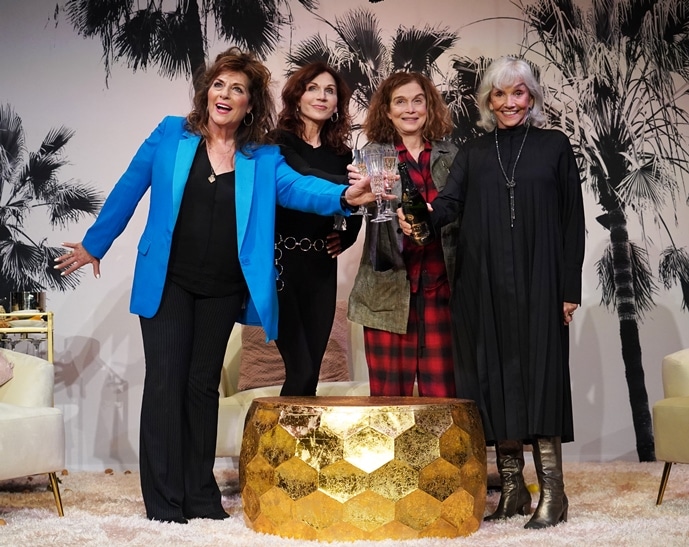
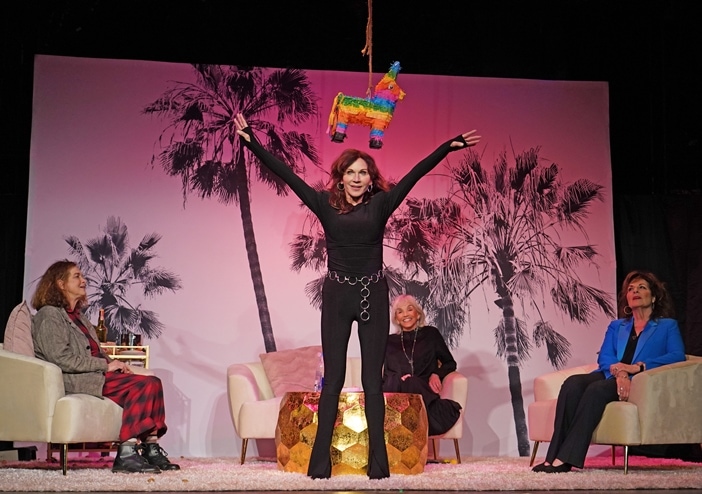
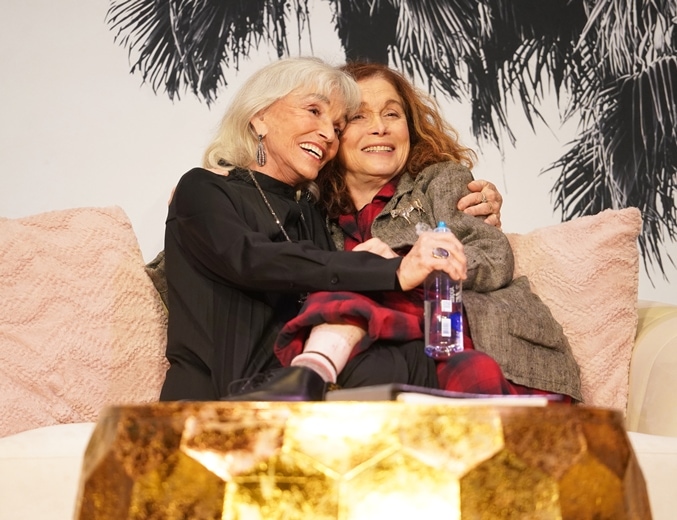
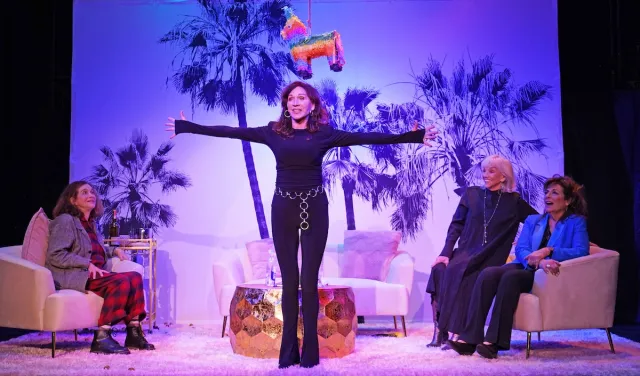
Caroline Aaron, Marilu Henner, Melanie Mayron, and Brooke Adams. Photo by Carol Rosegg.

The show opens with Aaron directly addressing the audience with a story about her first introduction to the Actors Temple three decades ago by Shelley Winters (“yes that Shelley Winters”), which proves to be the first of many breaks by the cast through the fourth wall, as they shift back and forth between their roles and themselves. Loh’s characters even have many of the well-known attributes of the real-life women, including Henner’s “highly superior autobiographical memory” (HSAM) or hyperthymesia, a rare brain condition, diagnosed in less than 100 people worldwide, which enables her to remember everything that ever happened to her, with precise dates and details. They also make running jokes about the show’s low budget, supposedly (but intentionally) providing for minimal props and design elements (many of which they mime or ask us to envision). The result is a greater sense of the actresses’ personal connection to the story, its outspoken humor, and their audience of enthusiastic fans, who get all the inside jokes (except for the one about Brentwood that doesn’t hit in NYC but “would get a big laugh in LA”).

Each woman is given her moment in the spotlight, beginning with Aaron’s riotously, unapologetically feisty Marilyn, a dedicated teacher and founder of a girls’ school, who doesn’t quite understand the dramatic rise in “the trans wave” or the current use of pronouns, is cheating on her pre-diabetic sugar cleanse and is smoking again, whose retired husband is around the house too much and is getting on her nerves, and who never even tries to hide her aversion and hilarious reactions to Henner’s vain Zoey (making a grand entrance down the center aisle and striking poses throughout the show), her long absence in London and lack of contact with the close-knit group, phony British accent, or sexualized conversation and behavior (with a tour-de-force sequence of eye-rolling, head-shaking, face-covering, and accent mocking) – all setting the stage for a disastrous reunion brunch but an uproarious comedy with masterful performances.

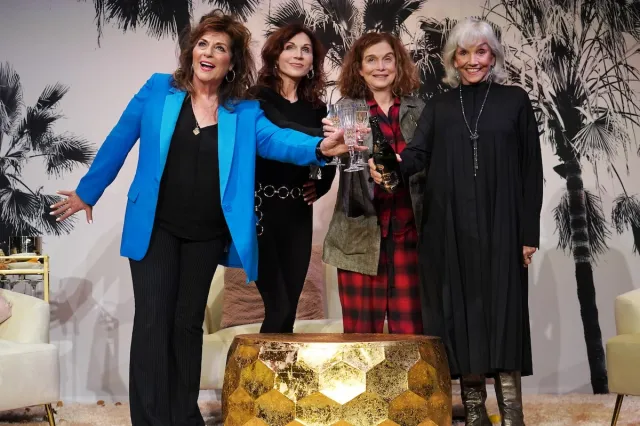
Marilu Henner (center), with Melanie Mayron, Brooke Adams, and Caroline Aaron. Photo by Carol Rosegg.

Mayron’s Claudia – a previously acclaimed but now struggling photographer who is “vaguely Jewish, vaguely lesbian . . . not the new kind, the old-fashioned kind,” hates surprise parties, is suffering from depression, and is being ghosted by her trans child JJ over an argument they had – shows up in her plaid flannel PJs and work boots and lets herself in with the key she has to Jules’ house, unaware of the planned celebration (cheaply decorated by Marilyn, though all we see is a colorful piñata hanging in the center of the room, due to the low props budget), then tries to leave once the tirades begin, but only makes it to the edge of the stage (thanks to Uber). And Brooke Adams’ Jules, called out by an angry Claudia as “passive aggressive and controlling,” is generally less forcefully combative, though she, like the others, has a couple of big reveals of her own that she’s kept beneath the surface (and in her water bottle), until she doesn’t.

Brooke Adams and Melanie Mayron. Photo by Carol Rosegg.

The ostensibly non-existent budget adds to the meta-theatrical gags, though the tastefully simple modern set by Christian Fleming, with a painted backdrop screen of palm trees and a rolling bar cart, efficiently set the scene in upscale Brentwood, with lighting by Pamela Kupper and sound effects by Max Silverman that surprise the cast. And the character-defining costumes did not come from their own closets, as we are told, but were well-designed by Sharon Feldstein and Erin Hirsch.

Will the friendships survive? Will these women support each other when no one else in our still sexist and ageist world does? Find out for yourself at Actors Temple, in the highly entertaining, funny, and relevant Madwomen of the West.

Running Time: Approximately one hour and 45 minutes, without intermission.

Madwomen of the West plays through Saturday, December 31, 2023, at Actors Temple Theatre, 339 West 47th Street, NYC. For tickets (priced at $48.50-130, including fees), call (212) 239-6200, or go online.

“Under the genially loopy direction of Thomas Caruso, “Madwomen of the West” is an extremely relaxed evening in the theater.”

‘Madwomen of the West’ Off Broadway Review: Four Famous Faces Stage a Wild Reunion 🔗
Robert HoflerThe Wrap

Melanie Mayron, Marilu Henner, Brooke Adams and Caroline Aaron headline a birthday brunch from hell.

Madwomen of the West Off Broadway
“Madwomen of the West” (Credit: Carol Rosegg)

If it has been a while since you’ve seen Melanie Mayron, Marilu Henner, Brooke Adams or Caroline Aaron onscreen or on TV, so it’s nice to report that they are all having a very good time together at the Actors Temple Theatre in Sandra Tsing Loh’s comedy “Madwomen of the West,” which had its New York City premiere Monday.

At their very best, these four actors make the case that everyone should be a post-menopausal woman. At her very best, Loh keeps the women at each other’s throat to great comic effect for most of this one-act 100-minute play.

Only occasionally along the way, and especially at the end, do these four feisty female characters play nice with each other and, in effect, dilute the fun. The four of them are most engaging when playing a drunk (Adams), a show-off (Henner), a slob (Mayron) and a bigot (Aaron).

Under the genially loopy direction of Thomas Caruso, “Madwomen of the West” is an extremely relaxed evening in the theater. Aaron kicks things off by telling a story about the Actors Temple, which is also a functioning synagogue on Fridays, and how during rehearsals of Paul Mazursky’s 1993 movie, “The Pickle,” Shelley Winters left the company briefly, with Aaron in tow, to observe Yom Kippur at this synagogue in Hell’s Kitchen.

Later, when the play finally gets going and a line doesn’t get a laugh, Aaron informs us that the comment got a big response in Los Angeles. And “Madwomen” may also be the first play at which the audience gets to vote on whether there’s going to be an intermission or not.

Since Aaron’s blousy, outspoken character Marilyn really hates Henner’s svelte, super-successful character Zoey, and since Marilyn also smokes, cheats on her diet and has problems with gender nonconforming pronouns, it goes without saying she walks away with most of the laughs. Frankly, Aaron turns mugging into an art form. Watching her react to Henner’s monologue on Zoey’s vulva is a comic highpoint not to be missed.

Mayron occasionally steals the spotlight back in her role as the pajama-wearing lesbian of the group, who also has the comic advantage of not having spoken to her transgender child for a few days. To escape the toxicity of her friends on her birthday, Mayron’s Claudia dials up an Uber that never arrives.

That’s unfortunate for Claudia, since it means she has to be there for Loh’s sitcom let’s-all-get-along finale.

“Directed to a fare-thee-well by Thomas Caruso.”

MADWOMEN OF THE WEST: HENNER, ADAMS, MAYRON, AARON LET LOOSE 🔗
David FinkleNew York Stage Review

★★★☆☆ Sandra Tsing Loh’s play about the stage-screen-tv performers reuniting, Thomas Caruso directs

Melanie Mayron, Marilu Henner, Brooke Adams, and Caroline Aaron in Madwomen of the West. Photo: Carol Rosegg

Whoa, what have we here right on a local stage? Why, it’s — in alphabetical order — Caroline Aaron, Brooke Adams, Marilu Henner, and Melanie Mayron, all beloved for big screen, little screen, and stage appearances over several decades. (You do the math on their ages, if you’re so inclined.)

The four have been rounded up to participate in Madwomen of the West — a play by Sandra Tsing Loh, already a Los Angeles long-run. In it they don’t play themselves, but characters specifically based on themselves and their enduring four-way friendship. Caroline is Marilyn, Brooke is Jules, Marilu is Zoey, Melanie is Claudia.

To what extent are they so much like themselves?  More than once Henner, known for having an unusually good memory, is called on to demonstrate Zoey’s unusually good memory. For another instance, Aaron and Henner have talked on the phone just about daily for 40 years, which Marilyn and Zoey all but acknowledge here. For yet another instance, Claudia chats about the truths and specifics of being “vaguely Jewish, vaguely lesbian,” which Mayron is, perhaps minus the “vague.”

British character actor Robert Morley was asked one late night by Jack Paar about his definition of good theater. He said, “Four people come out on stage, sit on a sofa and converse.” This is exactly what Aaron, Adams, Henner, and Mayron do, or close to.

They sit on three plush couches before a backdrop of palm trees (put there by set designer Christian Fleming) and banter non-stop. (They look smart in Sharon Feldstein’s casual outfits, although Mayron wears thick boots.”) Also, they don’t steadfastly remain seated throughout, as Bette Midler did when portraying Sue Mengers on Broadway some years back in John Logan’s I’ll Eat You Last monologue that kinda reads as a precursor to this enterprise.

The four madwomen, directed to a fare-thee-well by Thomas Caruso, are up and about possibly as much as a couple hundred times, standing and sitting and moving and sitting again and standing and sitting and rearranging. All the while they confront each other, justify each other, encourage each other, contradict each other, enjoy each other, and reminisce for about 100 nostalgia-filled minutes. Incidentally, Caroline and Jules, have gathered to celebrate Claudia’s birthday. Zoey, who long estranged herself from the others for any number of lucrative projects, is a surprise guest.

What do they talk about? A better question is, what don’t they talk about? When Mayron as Claudia recalls performing a certain handy service for an aroused male, it’s clear nothing is out of bounds. Intermittently, they render bits of Elton John’s “The Bitch is Back.” The implication is that from time to time they (as do many women) like thinking of themselves as bitches.

Which specific topics are discussed as four-letter words slice the air? Marilyn, pre-diabetic, mentions not sticking closely to her prescribed “sugar cleanse.” They bring up “the trans thing.” Zoey goes on rather grandly about the “granularity of life.” Breast surgery is recounted. Of Donald J. Trump taking office in 2017, Marilyn blurts, “How ‘bout those f*****g pussy hats?” and rails on. A few husbands, Gloria Steinem, a Michael Pollan bouillabaisse, a Peloton instructor, puberty and menstruation are mooted — and more, until sober confessions of their feelings about each other take late precedence.

(Incidentally, occasional audience participation occurs. Aaron, as designated emcee, puts the okay on that at the informal get-go. Eventually, patrons are even encouraged to sing the title ditty from The Mary Tyler Moore Show. Many are happy to do so. Playwright Loh, you see, knows the movie-and-tv-lovers-of-a-certain-age to whom she’s appealing.)

Much of what gets discussed in a spectrum of moods is funny as well as pertinent. During this “girl-talk” affair, however, more than seems helpful comes across as forced. Indeed, there are times when the correct entertaining approach for arranging a theatrical Aaron-Adams-Henner-Mayron reunion might have been to let them gab about their actual experiences rather than spouting those lived by the fictional Marilyn, Jules, Zoey, and Claudia — something along the lines of The View.

Wait a sec. Perhaps playwright Loh has modeled her stand-in characters so closely on the originals that they are already speaking as and for themselves — and as themselves are also representing women everywhere when talking candidly with no men present.

One certainty: Playing either themselves or versions of themselves, they’re extremely convincing at it. On that score, audiences won’t come anywhere near being disappointed. After all, the casting is truly the point here, isn’t it?

Madwomen of the West opened December 4, 2023, at the Actors Temple Theatre and runs through December 31. Tickets and information: telecharge.com

David Finkle is a freelance journalist specializing in the arts and politics. He has reviewed theater for several decades, for publications including The Village Voice and Theatermania.com, where for 12 years he was chief drama critic. He is also currently chief drama critic at The Clyde Fitch Report. For an archive of older reviews, go here. Email: [email protected].

“An entertaining show breezily directed by Thomas Caruso…Under Caruso’s assured direction, the four stars seem as comfortable on the stage as in their own living room.”

Review: Women of a Certain Age Have Their Say in Madwomen of the West 🔗
Zachary StewartTheater Scene

Marilu Henner and Caroline Aaron star in Sandra Tsing Loh’s chatty drama.

Madwomen046R
Caroline Aaron, Marilu Henner, Melanie Mayron, and Brooke Adams star in Sandra Tsing Loh’s Madwomen of the West, directed by Thomas Caruso, at the Actors Temple Theatre.
(© Carol Rosegg)

Is there any group of people more taken for granted by the theater (by the world) than older women? They’re expected to check their privilege with their coats and make space while quietly paying full admission at many of our most prestigious venues. Deviate from this routine, and you run the risk of being branded a Karen. Stay in your place, and you continue to be practically invisible. Well, at least at the by-no-means prestigious Actors Temple, old ladies are getting their say in Sandra Tsing Loh’s provocative Madwomen of the West.

It’s the sixty-[redacted] birthday of Claudia (Melanie Mayron), a photographer whose career is on the wane. Jules (Brooke Adams) hosts the event in her Brentwood home, while Marilyn (Caroline Aaron) rustles up some Party City decorations and a pupu platter. They settle in for a cozy brunch among friends, but all that changes when they learn of the imminent arrival of their estranged fourth, Zoey (Marilu Henner).

Marilyn cheats out to the audience and asks, “Our former actress friend turned international wellness guru?!?” — as if the two other women at the party don’t know exactly who she is. Loh cheekily plows through such exposition with a script that is both self-aware and self-deprecating. The goal was never to write a perfectly crafted drama, with timeless human quandaries springing seamlessly from an airtight plot. Rather, Loh seems interested in placing four women of a certain age, but with different perspectives, onstage where they can hash it out. That makes this play feel like a long “Hot Topics” segment on The View, beyond the watchful eye of the mouse and his team of HR enforcers.

“Five years ago, less than 1% of the U.S. said they were trans,” says Marilyn. “This year, at Westgate Girls School? An entire third of 8th grade is trans…It’s the new bulimia.” She later ponders, “I wonder: if this taking hormones, and having surgery — If this ‘I don’t want to be a girl’ thing is just one more way for teen girls to hate themselves.” This is a suspicion I’ve never heard uttered from the stage of an off-Broadway theater, but it’s one that millions of reasonable people certainly have. By putting it in her show, Loh not only meets her audience where they are, but scoops up rich dramatic material from the floor where it has been so carelessly discarded.

Obviously, the other women don’t see things exactly the way Marilyn does (Claudia has a trans child, which isn’t to say she’s fully onboard). And therein lies the drama, as these four women grapple with menopause, professional expectations, shifting marital relationships, and the nagging disappointments of womanhood in America.

Caroline Aaron, Marilu Henner, Melanie Mayron, Marilu Henner, Brooke Adams, and Caroline Aaron star in Sandra Tsing Loh’s Madwomen of the West, directed by Thomas Caruso, at the Actors Temple Theatre. (© Carol Rosegg)

Aaron makes a particularly compelling advocate for her character, a liberal educator caught in the riptide of shifting culture. She turns to the audience and says, “God, do we need Hillary now? RIGHT?!?” And by the raucous response, you’d think she was talking about the Kaiser to a group of Prussian Junkers circa 1931. Every line is so sharp, every retort so perfectly timed, that we leave with no doubt about who Marilyn is and what she stands for. We can easily imagine her becoming the charismatic dictator of a new country, the borders of which roughly align with the Upper West Side.

The other three actors match her passion, if not her precision. Adams conceals Jules’s incandescent rage behind an innocuous smile. Mayron’s Claudia conveys the exhaustion of a woman who has spent years fighting on multiple fronts. In contrast, Henner beams onstage like an aggressive ray of sunshine. Rich and famous, her Zoey has ostensibly won the game by embracing a granola-munching, kombucha-guzzling vision of contemporary womanhood (a late monologue about masturbation serves as a climax). Part of the fun of Madwomen of the West is seeing how the people who know her best, her true friends, chip away at that façade.

Thomas Caruso directs with a light hand, delivering a well-paced staging that mostly stays out of the way of the performers. Christian Fleming’s faux-ritzy scenic design (the golden pineapple coffee table is especially hideous) offers an appropriate setting for this live chat show, with well-selected costumes by Sharon Feldstein and Erin Hirsh. The lights (by Pamela Kupper) and sound (by Max Silverman) create little theatrical embellishments, so we’re never under the delusion that what we’re witnessing is strict realism — even if the views expressed are quite authentic.

As contrived as it is, Madwomen of the West still fascinates with its unapologetic and humorous depiction of older women and their grievances, and would make an ideal post-brunch activity for you and your close circle of friends. It’s sure to get you talking.

Featured In This Story

C3 NY PlaybillAd Page 1

Madwomen of the West

Off-Broadway

Final performance: December 31, 2023

Buy Tickets

“Remember the way things used to be? Like in 1973, a mere half-century ago. That’s where Incident at Our Lady of Perpetual Help transports us, mixing nostalgia with timeless lessons about the folly and disservice of parental stereotypes, and the abuse of power by the powers that be, a role that, in this case, is portrayed by organized religion.”

Incident at Our Lady of Perpetual Help at Penguin Rep 🔗
Bruce AparBroadway World

Thoughtful Memory Play Runs through July 16

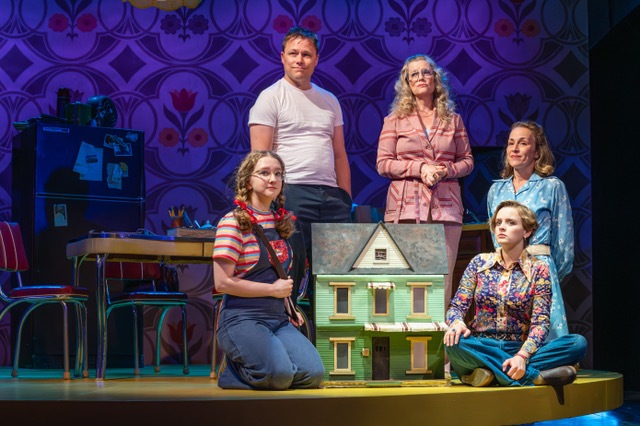
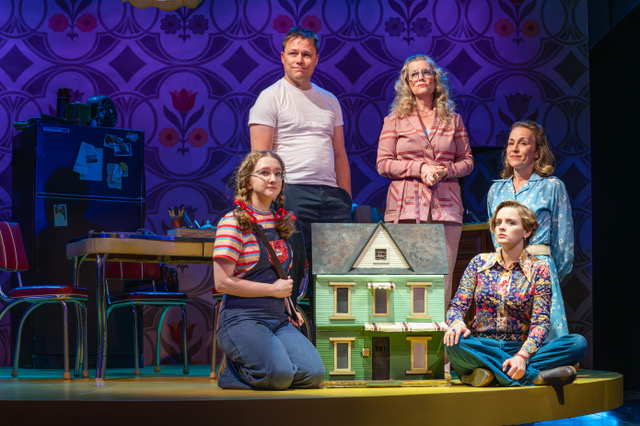
Pictured clockwise from left: Gabriella Cila (Becky), Mat Hostetler (Mike), Kellie Overbey (Terri), Jennifer Blood (Jo), Abigail Burris (Linda) Photo by Dorice Arden Madronero

Remember the way things used to be? Like in 1973, a mere half-century ago. That’s where Incident at Our Lady of Perpetual Help transports us, mixing nostalgia with timeless lessons about the folly and disservice of parental stereotypes, and the abuse of power by the powers that be, a role that, in this case, is portrayed by organized religion. 

Before a word is spoken in this Penguin Rep production (playing through July 16 in Stony Point, Rockland County, N.Y.), the set design instantly informs us what we’re about to witness harks to a bygone era. 

As the synopsis says, it is the age of “bell bottoms, cassette tapes and landline phones” and, yes, people even wrote letters in longhand and smoked like chimneys (even after the cigarette cancer warning label was issued). 

WOMEN’S LIB

It also is the time of the women’s liberation movement, a signal inflection point in American society that informs what playwright Katie Forgette has wrought. 

There before us, on stage, in this lower-middle-class household, are the red plastic dining table chairs with tube metal frames, the faux-leather lounge chair, the jumbo-tulip-pattern wallpaper that looms over everything like an all-seeing presence. And there is a heck of a lot to see in this family’s travails.

We are at the home of the O’Sheas, of proud Irish Catholic stock, who are fearfully faithful to the demands of their parish as well as to their heritage. We hear more than once invocation of the potato famine as a bitter, life-threatening  lesson in the strength gained through suffering.  

MEMORY PLAY

Our guide is ebullient, independent-minded 19-year-old Linda O’Shea (played by Abby Burris), who tells us this is a memory play, “which means a lot of it is false.” Who cares about accuracy if there’s enough entertainment to be had in the telling, and there’s enough fast-paced diversion here to make its running time feel shorter than it is, a credit to veteran director Thomas Caruso

Our teenage narrator wears stylish bell-bottoms (a nod to the suburban hippie affect of the day) and is jazzed about attending graduate school at brainy Stanford University on a scholarship. Linda has designs on becoming a writer along with (unseen) boyfriend Buzz, whose hairiness is a running joke that – like the relentless classic movie references – is colorful and playful and threatens to wear itself out. (And I love classic movies of the 1940s forward.)    

THE FAMILY O’SHEA
The remaining characters are indelibly drawn and sharply acted, so that, by the play’s end, we feel like we know them well. There’s Linda’s hard-working, gruff father Mike (Mat Hostetler), tireless homemaker and church stalwart mom, Jo (Jennifer Blood), sassy one-woman Greek chorus of an aunt, Terri (Kellie Overbey), and little sis, Becky (Gabriella Cila), whose alter ego is a film noir detective in the mold of Humphrey Bogart. Get a load of this 13-year-old’s rakish fedora and tent-size trench coat, and her sidekick tape recorder, which gets her family into trouble with the self-righteous parish priest and obnoxious parishioner Betty Heckenbach (both played by Mat Hostetler quite convincingly). Judging by her tell-tale sharp tongue, Betty’s favorite entertainer no doubt was insult comic Don Rickles

EXPLORING FAMILY LIFE

The play’s storyline, such as it is, involves Linda taking on the big-sister assignment of filling in Becky about the facts of life. But that conceit really is a rather slender thread in the service of Forgette exploring the role of organized religion in family life and the role of family life in shaping the future adult into which young people grow. 

Allowing for the humorous moments that writer Forgette works to extract from this slice-of-life portrait of a 1970s family who come together to protect one of their own – and their own community standing – in the end the dramatic subtext makes “Incident at Our Lady of Perpetual Help” more dramedy than comedy. The denouement here – in the form of an epilog describing the future course of each family member – is true-to-life in a way that the typical Hollywood comedy or even drama is not. 

PRACTICE VS PREACH

As paterfamilias of the O’Shea clan, Mike is used by Forgette to score points about the hypocrisy of a certain kind of clergy who preach the lessons of the Good Book out of one side of their lectern while practicing a dissonant set of values in their personal lives. 

When Mike comments on Father Lovett’s prized Cadillac (he also has a hi-fi and color TV), it is less with envy than with disdain. (Yes, Virginia, in the early 1970s color TVs were still a semi-luxury, not yet owned by almost half the U.S.)

As materfamilias, Jo O’Shea is the saint of the flock. The generation gap between her and Linda is inflected by her daughter’s allegiance to the women’s lib movement. It was the era of ERA (Equal Rights Amendment) and Betty Friedan’s NOW (National Organization of Women), forging a divisive national conversation about the legacy male-female compact, where man is the hunter-gatherer and protector and woman is the everything-else-her. “Wives be subject to your own husbands,” quotes the priest from the Bible, “as to the Lord.” Linda, meanwhile, is eager to write for Gloria Steinem’s Ms. Magazine.

There’s a lot going on in “Incident at Our Lady of Perpetual Help, and it is handled with impressive flair and stagecraft by the cast and creative and technical teams. 

Christopher Fleming is Scenic Designer; Vanessa Leuck is Costume Designer; Pamela Kupper is Lighting Designer;, Joel Abbott Sound Designer; Bobbie Zlotnik is Wigs); Buffy Cardoza is Property Designer); Michael Palmer is Production Stage Manager.

PenguinRep.org; 845-786-2873